
I took out a Masterclass annual membership for one year to help my creative writing and watched as many courses as I could. Here’s what I learned from the best-selling authors and poets (and big names from stage and screen) presenting the courses…
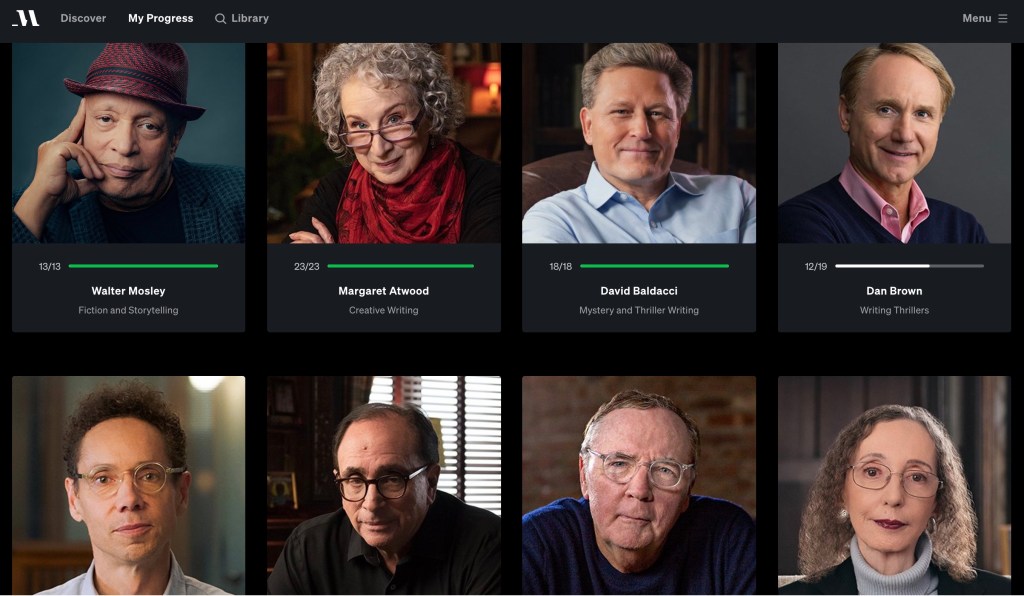
Joyce Carol Oates
- Take titbits from life.
- Sharpen up your observation and listening ear.
- Keep a diary – even that’s writing.
James Patterson
- Plan your chapters (to a synopsis) and write several drafts of that plan
- If you’re stuck, move on and come back to it later – just keep going.
- Exist in the location of your story when you’re writing. Be ‘there’.
- Research the ‘bee sting’ – if a character is stung by a wasp, research it.
Judy Blume
- It’s okay to be a messy writer.
David Sedaris
- Speak to everyone and note what they say.
- Ask mad questions and do mad things.
R L Stine
- Say ‘yes’ – to everything.
Malcolm Gladwell
- Think where to put a paragraph (or punch) to achieve maximum impact for the reader.
- The perfect is the enemy of the good – don’t spend time making everything perfect because you’ll never finish.
Dan Brown
- Keep to the three C’s: Keep your end of the contract with the reader by delivering your promises, set your story in a crucible, set the clock ticking.
David Balddici
- This is your career: be professional, be committed, know the business.
Neil Gaiman
- Read as a reader.
- Don’t be scared of walking naked down the street;
- Give your characters what they (might not know they) need – even if it’s to be released from this life – not what they think they want.
- Listen to your characters.
- Reinforce what your story is about (this reminds me of what Stephen King says about theme).
Margaret Atwood
- There are three perspectives of a character: their own, the one they are trying to create, and the one others have of them.
- Try shutting down a sense when describing place (e.g. sight).
- When revising, fix the big things first
- Do a little research as you go.
David Mamet
- Do dialogue rhythmically
- Think what can you do without, not what can you put in – take off the excess flesh (if you take a scene out, would the audience miss it?) but don’t cut too deeply.
- Every scene must answer the questions who wants what from who, what happens if they don’t get it, and why now?
- Make the audience gasp, make them laugh – if you can, you’ve done something special.
- Find the truth.
Aaron Sorkin
- Drama = strong intention meets formidable obstacle
- Don’t judge your characters, even if they’re bad
- Dialogue is music.
- The audience/reader should feel the emotion – not the character.
Steve Martin
- Write freely.
- Take ‘off-story’ excursions.
- What’s the problem – and how can you make it worse?
Judd Apatow
- The best way to be original is to be specific.
- Serve the story with every scene.
- Get to the core of the character.
- Introduce characters with a bang!
- Don’t be lazy – push yourself to do your best work.
Salman Rushdie
- You can reject three-act structure as the only form of telling a story. If you listen carefully, the story will tell you what form it needs to take.
- Everything that happens to a character is not only significant in their life, but also in the lives of the other characters.
- Use echoes and mirrors – scenes can be an echo of or mirror previous scenes.
- Introduce characters with the most idiosyncratic aspect of them. Think Leopold Bloom in Ulysses.
- Ask ‘am I saying too much/little with every line’
- Know yourself – and ask what do you want to tell the world about yourself through the story; are you a minimalist or maximalist writer?
- Take real/artistic risks!
Walter Mosley
- Plot is the structure of revelation.
- Write your history – background, environment, town etc – into fiction so that it exists.
- Live your fantasies through writing! Say things you can’t say in real life.
- Join a writers’ workshop.
Billy Collins
- Poetry is a mix between clarity and mystery. Be brave sometimes and turn the mystery cards face up.
- Surprise yourself sometimes by letting go and taking that side road.
- Free write (said by Marie Howe)
- The act of composition should be an experience

