Masterclass review: is it worth buying a subscription?

I took out a Masterclass annual membership for one year to help my creative writing and watched as many courses as I could. Here’s what I learned from the best-selling authors and poets (and big names from stage and screen) presenting the courses…
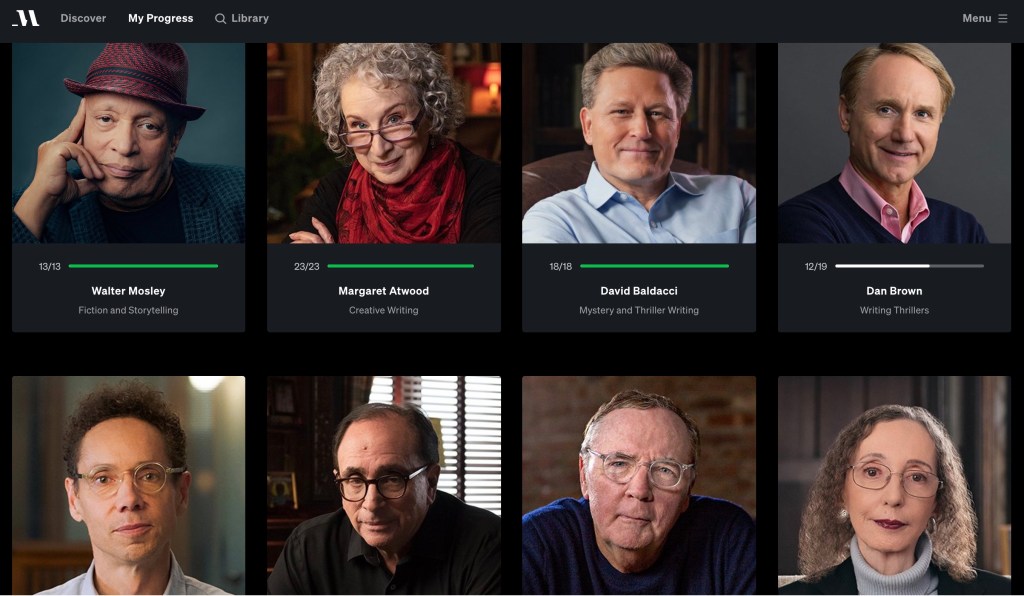
Joyce Carol Oates

  • Take titbits from life.
  • Sharpen up your observation and listening ear.
  • Keep a diary – even that’s writing.

James Patterson

  • Plan your chapters (to a synopsis) and write several drafts of that plan
  • If you’re stuck, move on and come back to it later – just keep going.
  • Exist in the location of your story when you’re writing. Be ‘there’.
  • Research the ‘bee sting’ – if a character is stung by a wasp, research it.

Judy Blume

  • It’s okay to be a messy writer.

David Sedaris

  • Speak to everyone and note what they say.
  • Ask mad questions and do mad things.

R L Stine

  • Say ‘yes’ – to everything.

Malcolm Gladwell

  • Think where to put a paragraph (or punch) to achieve maximum impact for the reader.
  • The perfect is the enemy of the good – don’t spend time making everything perfect because you’ll never finish.

Dan Brown

  • Keep to the three C’s: Keep your end of the contract with the reader by delivering your promises, set your story in a crucible, set the clock ticking.

David Balddici

  • This is your career: be professional, be committed, know the business.

Neil Gaiman

  • Read as a reader.
  • Don’t be scared of walking naked down the street;
  • Give your characters what they (might not know they) need – even if it’s to be released from this life  – not what they think they want.
  • Listen to your characters.
  • Reinforce what your story is about (this reminds me of what Stephen King says about theme).

Margaret Atwood

  • There are three perspectives of a character: their own, the one they are trying to create, and the one others have of them.
  • Try shutting down a sense when describing place (e.g. sight).
  • When revising, fix the big things first
  • Do a little research as you go.

David Mamet

  • Do dialogue rhythmically
  • Think what can you do without, not what can you put in – take off the excess flesh (if you take a scene out, would the audience miss it?) but don’t cut too deeply.
  • Every scene must answer the questions who wants what from who, what happens if they don’t get it, and why now?
  • Make the audience gasp, make them laugh – if you can, you’ve done something special.
  • Find the truth.

Aaron Sorkin

  • Drama = strong intention meets formidable obstacle
  • Don’t judge your characters, even if they’re bad
  • Dialogue is music.
  • The audience/reader should feel the emotion – not the character.

Steve Martin

  • Write freely.
  • Take ‘off-story’ excursions.
  • What’s the problem – and how can you make it worse?

Judd Apatow

  • The best way to be original is to be specific.
  • Serve the story with every scene.
  • Get to the core of the character.
  • Introduce characters with a bang!
  • Don’t be lazy – push yourself to do your best work.

Salman Rushdie

  • You can reject three-act structure as the only form of telling a story. If you listen carefully, the story will tell you what form it needs to take.
  • Everything that happens to a character is not only significant in their life, but also in the lives of the other characters.
  • Use echoes and mirrors – scenes can be an echo of or mirror previous scenes.
  • Introduce characters with the most idiosyncratic aspect of them. Think Leopold Bloom in Ulysses.
  • Ask ‘am I saying too much/little with every line’
  • Know yourself – and ask what do you want to tell the world about yourself through the story; are you a minimalist or maximalist writer?
  • Take real/artistic risks!

Walter Mosley

  • Plot is the structure of revelation.
  • Write your history – background, environment, town etc – into fiction so that it exists.
  • Live your fantasies through writing! Say things you can’t say in real life.
  • Join a writers’ workshop.

Billy Collins

  • Poetry is a mix between clarity and mystery. Be brave sometimes and turn the mystery cards face up.
  • Surprise yourself sometimes by letting go and taking that side road.
  • Free write (said by Marie Howe)
  • The act of composition should be an experience

What Mohsin Hamed says about writing

Back at the end of October last year I attended ‘The Man Booker at Birkbeck’ talk for 2018, featuring that year’s guest Mohsin Hamed, the author of the exceptional The Reluctant Fundamentalist and the yet-to-be-read-by-me Exit West (although I picked up a free copy of the book at the annual London event, so it’s just a question of time before I do).

He was interviewed on-stage by Birkbeck University’s Dr Anna Hartnell. However, with the exception of the first question below, she didn’t ask any of the others, being far too smart to be quite so simplistic…

What makes him write?

Feeling “confused, conflicted, upset” is apparently what sets the creative ball rolling

What does he write?

The obvious answer would be ‘novels’, but he calls his work “half-novels” – because he “leaves space for the reader” in order for them to animate them “into a full novel”.

His description was in response to being asked whether Lahore was the unnamed city in Exit West – Hamed replied that it could be if that’s the what the reader chooses it to be.

What’s The Reluctant Fundamentalist?

Okay, so this time the answer is ‘a novel’, but it’s a “dramatic monologue that replicates the filter bubble of today” in the sense that the reader only receives one side of the story, as people do with their social media newsfeeds. But in this case the reader can’t respond. As with a previous answer about leaving space for the reader to create the “full novel” – in the the context of the time of that text, the reader is “already scared before you start reading the book”.  The novel creates an atmosphere of dread and builds on what the reader is already thinking.

What form should a novel take?

Hamed believes that novels should not do what televisual modes of storytelling do – so that means not doing dialogue, and not ‘showing’, because that’s what TV does. So his advice is to do what TV/film/Netflix can’t do as well, and concentrate on internal feelings.

human using black and silver laptop computer
Photo by rawpixel.com on Pexels.com

Although that doesn’t mean novels aren’t allowed to steal some ideas from television – e.g. ‘jump cuts’.

Hamid also talked about the position that the narrator assumes relative to the book – i.e. he described the narrator in Charlotte’s Web as partisan and on the side of the character and reader, while the narrator in Anna Karenina is neutral (a point I found particularly helpful, as I always struggle with knowing how to think of, or position my narrators). Exit West empathises with the migrant, says Hamed, and in that sense we can relate to the book because we are all migrants; for instance, temporal movement is a form of migration – e.g. we are all refugees from childhood.

How would he describe his personality?

Finally, despite the subject matter of his books, Hamid described himself as an optimist, stating that “not genocide” is the true history of the world.

For a more in-depth and high-brow take on what was spoken about that evening, head to here: blogs.bbk.ac.uk.

Six writing tips from a published author

Use Post-It Notes – but not like this…

Last month I attended a talk on writing given by author Clare Swatman, which was organised by the Chiltern Writers.

Here’s what I learnt about her success in making the move from journalist to novelist and what I’ll try to incorporate into my own work as I attempt to sell another short story:

(1) You don’t have to write every day…

What! Surely that’ sacrilege? Interestingly, for her first book, ‘Before You Go’, Clare didn’t follow the mantra ‘write every day’; instead, due to the realities of life and circumstances,  she made full use of a free day she had every week. The key here, though, was that she absolutely dedicated that precious time to doing nothing else but write. In other words, it’s still a question of discipline, folks.

(2) …But you must know your characters.

Yep, we’re back to conventional advice. Part of Clare’s method involves filling in a detailed questionnaire for her characters. Google ‘character questionnaire’ and you’ll see the kind of questions you should be asking in order to get to know your characters inside out, create distinct voices, and maybe get taken down unexpected paths. Maybe try this one for starters. Interestingly, it’s one Vanity Fair has used for interviews with the likes of Margaret Atwood, Karl Ove Knausgaard, Norman Mailer, Zadie Smith, Elmore Leonard, and even Donald Trump (well, he is an author too).

(3) Be organised

A biggie for me because it’s a massive failing of mine. I tend to get a rough idea, get excited by it, and start running with it before it’s ready to walk, then have to go back and discover that, actually, I’ve missed out the crawling stage too. I then spend an age finding and fixing all the bugs. Clare uses Post-it notes stuck to a wall and a chapter-by-chapter synopsis to map out the story’s journey and destination. If I did this, it might help me maintain my focus and spend less time bumping my head against dead ends.

(4) Think about your style.

You might have writers you want to emulate – Clare certainly did, she’s a big fan of Margaret Atwood’s ‘The Handmaid’s Tale’ (and she’s right to be) – but discovered that trying to write in a literary style didn’t suite her and that a chatty style did. Lessons here include:

a) Don’t have preconceived ideas
b) Find your strengths
c) Be adaptable.

(5) Acknowledge research interviewees

Research sometimes involves speaking to people and I’ve always wondered how authors – particularly first-time, unknown ones – persuade experts to be generous with their time. According to Clare, a simple acknowledgment (in her case, within the pages of the published book) suffices. To back up her assertion, I once tried contacting actual scientists in the US for my short story ‘Space’ and was gobsmacked when one not only responded to my email but also answered my questions. Bottom line is, if you don’t ask, you definitely won’t get, and if you do get, try to be nice and say ‘thank you’ in print.

(6) Hold your ground when necessary – it’s your story

Having friends read your final drafts and – hopefully, at some stage – pros edit them is essential. However, you should also have the confidence to defend your corner when you disagree strongly with a suggested change because, as Clare found, people may well defer to your superior knowledge of your characters. So, be open-minded to all criticism, but stick to your guns if, after careful consideration, you believe a suggestion won’t work for you.


Grabbing the dream


A recent story in The Guardian began as follows: “A Manchester-based author whose debut novel was initially rejected by British publishers has won one of the world’s richest literary prizes.”

My immediate thought was what a heart-warming tale – a little person overcomes the odds and achieves an unlikely victory.

My second thought was that it was great to see someone I could relate to persevere and be rewarded for their total commitment.

A week or so later, a friend contacted me and described their own writing ambitions, and our conversation brought to mind a woman I once worked with years ago. Unknown to me at the time she had ambitions of becoming a writer and succeeded. 

Why am I telling you about these two tales of achievement? Well, I recently discovered that my short story, ‘Waste High’,  unfortunately didn’t get beyond the semi-final stage of the Futurescapes Writing Contest 2017.

Here’s what they said:

Thank you for participating in the 2017 Futurescapes Writing Contest. We had an extremely difficult time selecting winners from among our group of semi-finalists. Unfortunately, your story was not selected as a finalist.

That said, know that making it to the semi-final round indicates great strength and promise in your writing. Thank you for participating, and I strongly encourage you to enter the contest again in 2018.

So close but no cigar, and despite the nice words it was still a standard email that left me with a feeling of disappointment rather than encouragement.

Hence the tales: I know I, and I suspect we all, need to hear stories of success to help motivate us to keep blowing on our own embers of ambition. We need proof that living the dream – while improbable – is still possible

So, as the chorus lyrics to a song I wrote in a previous life went:

“Keep believing,
arm self-esteem.
In the quest for life
grab a dream
and don’t let go.”

‘Growing’ on ‘the journey’

It’s taken me a long time to finish my most recent short story, called ‘Space’ – I’m talking at least two years, maybe three – and ‘the journey’ (that’s so beloved of reality TV contestants) has been painful.

But rewarding.

That’s because I learnt a lot about not only my writing style and what works for me, but also about the shortcomings of how my mind constructs not so much sentences as thoughts.

I’ve discovered it isn’t pretty, that the muddled sentences of early drafts are reflections of my muddled mind, and that my editing process has been akin to finding the end of a tangle of wool and trying to pull it straight so that I can work out what it is I’m trying to say and communicate that clearly to the (currently non-existent) reader.

While the story itself may or may not be any good, I feel that I’ve ‘grown’ (another reality TV staple) and that my next effort will build on this experience. I’ve also realised I should follow points 11 and 12 of my Stephen King blog regularly.

Being published keeps your soul warm

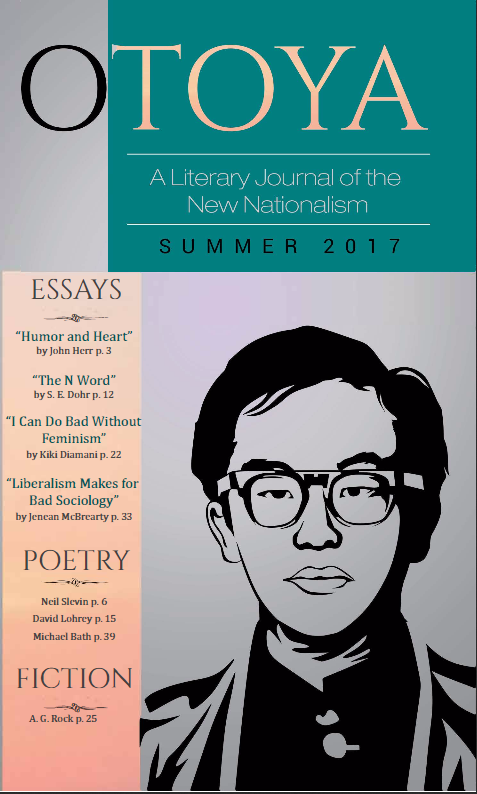
I’ve had my first short story published. The publication is a brand-new, small-time, print-on-demand US one called Otoya (you can buy it here). It’s named after a Japanese ultra-nationalist, and the story that appeared in it was called The English Neigbour, a tale about nationalism. So a good fit, then (there’s a lesson there).

otoya_2017fall

I was delighted to have my first piece published and paid for – it’s the best paycheque (PayPay transfer, actually) I’ve ever received. It’s taken me years to get to this point, and it felt good because I felt vindicated at last – another entity other than my ego thought a story of mine was worth sharing.

However, this small success has been followed by a prolonged period of writing inactivity as I’ve allowed the weekday job and the weekend-and-evening family to crowd in on what little writing time I had. Much to my frustration.

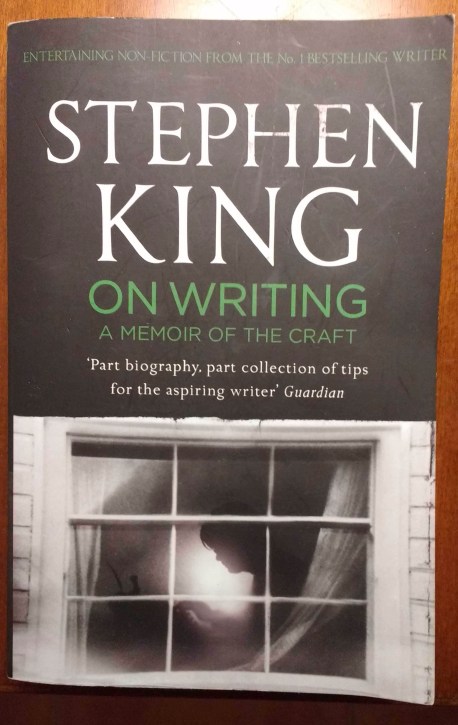
I think the problem hasn’t been that I’ve become suddenly complacent (although that is possible), but that having recently read Stephen King’s On Writing I’ve allowed myself to believe that I need a set, ideal daily writing time in order to achieve anything, and while this is undoubtedly a better scenario than my previous grab-a-spare-moment approach, clearly writing something at random times is better than writing nothing at all.

Hopefully, I’m over the worst of this unenforced ‘rest’ period, and can get back to the black keys with the white symbols that are taking a battering here.

It’s time to prove that Otoya wasn’t a one-off lucky strike, and that I have the determination and talent to repeat this trick several times.

Wish me well, comrades, and I will do the same for you, because I can tell you that with such success as I have now experienced, as marginal as it may be in the grand land of writing triumphs, comes an inner smile that keeps your soul warm.

Stephen King’s ‘On Writing’ – what I have learned

Stephen King’s ‘On Writing – A Memoir of the Craft’ is regularly cited as a must-read book for would-be authors. So I’ve read it. And here are the key lessons I’ve taken from Mr. King, listed under two of the same section headings he uses within the pages of his book.

   C.V.

  1. Your job isn’t to find ideas but to recognise them when they show up in your head (see point 19).
  2. When you first write a story, you’re only telling yourself the story. It’s yours – warts and all. When you’ve finished rewriting a story, it belongs to everyone else – so you’d better take out the warts.stephen-king.jpg
  3. Good writing can be both “intoxicating and idea-driven”.
  4. Writing stories has as much in common with sweeping the floor as moments of revelation.
  5. “Writing is a lonely job. Having someone who believes in you makes a lot of difference.”
  6. There is no excuse to ever stop writing – even when you’re a sad alky or have been hit by a truck, keep writing.
  7. Take writing seriously. Not yourself.
  8. “The word is only the representation of the meaning; even at its best, writing almost always falls short of full meaning.” So you’d better find the closest word if you wanna get heard.
  9. Learn about gerunds…
  10. …but not every line has to be grammatically correct.
  11. KISS for the sake of the reader. Therefore, two thoughts = two sentences.
  12. Accept it: you will write badly at times and fail with your rewriting occasionally. Even the good authors are bad in places.
  13. Writing is talking and talking is seduction. You’re trying to get the reader to dive under the covers… of your book.

    Writing

  14. The muse with the bag of magic fairy dust will only open it and sprinkle a little in your direction when you graft.
  15. Read.
  16. Don’t watch telly.
  17. Read and write 4-6 hours a day (gulp!)
  18. Shut the door until you achieve your daily writing goal. Lock it if you have to with a ‘disturb and die’ sign on the outside. Eliminate every distraction – mobile, internet, windows etc. Find your ‘zone’, which could mean plugging into your iPod.
  19. Your other job is to “find the truth inside the story’s web of lies” (read point 1 if you haven’t already).
  20. Characters must do things their way. Let them surprise you. Allow them to complicate matters.
  21. Describe what you want the reader to experience.
  22. Don’t break the narrative spell – keep the ball rolling.
  23. Let your characters speak freely – express the truth (there’s that word again – see point 19) of how people really act and talk. Don’t self-censor.
  24. Can the theme of your story (its deeper meaning) enrich the 2nd draft?
  25. 2nd draft = 1st draft – 10%
  26. You really must know the market before submitting.

I am an ape, I’m your entertainer, you are my civilising influence

Mark Stygg recently spent a few hours in a roomful of decent, pension-aged white men.

Being friendly, they had invited him, a middle-aged neighbour, into one of their homes for a drink and nibbles to watch a televised sporting occasion, when one of them likened a mixed-raced player to a “gorilla”.

Styggy shifted uncomfortably in his seat and wished for the moment to pass without it turning into an awkward silence, although he needn’t have worried as no one else batted an eyelid.

Days later, an old school acquaintance of Styggy’s now living in Brussels used social media to reshare a photo, taken a few years ago, of his white child wearing black face paint.

Again, Styggy shifted uncomfortably, this time in his home.

The following weekend he was sat in a bar watching another sporting event, when a smartly dressed, elderly white gentleman approached and asked, politely, if Styggy was East African because Styggy looked like the Masai the man had seen in his time in that part of the world – to which Styggy, equally politely, explained in his Home Counties accent that he was, in fact, of Afro-Caribbean descent.

Had the final event occurred in isolation it’s doubtful whether the exchange would have bothered Styggy, and he might well have thought that all that had occurred was that his physical appearance had transported an old man back to his youth and a land of fond memories.

But it had come on the back of the two other incidents, which raised two questions in Styggy’s mind: Were they somehow linked? And why had they occurred now?

Styggy’s conclusion? That from his perspective all three were subconscious assertions of racial superiority.

Dehumanisation

In the first incident, the dehumanisation of the sportsman – by comparing him to an ape, a subhuman – elevates the pensioner’s relative position within society.

In the second, black social media users would have seen an image that, for them, cannot be separated from its historical context: throughout the 19th and 20th centuries some white-skinned entertainers performed as minstrels by wearing black and white facial make-up that overly exaggerated perceived Negro characteristics. In doing so they reinforced some racial stereotypes – that all black people look alike and excel at dancing and singing. Like the ‘gorilla’ comment above, the ‘blacked-up’ face is dehumanising, in this instance because it assigns a couple of defining, simplified, characteristics to a race, and rejects the notion of black people as individuals with as many, varied traits as any other racial group.

Styggy didn’t find the third event dehumanising, but did feel that by evoking a place and time – Tanzania in the middle decades of the 20th century – the gentleman was channelling a racial hierarchy from his past (when Britain still had colonial clout and he had enjoyed a privilege due to his nationality, accent and pigmentation) and projecting it onto the present.

Gentle and insidious

Styggy believes no harm was intended in any of the three incidents (in fact, he imagines that all those involved would be either horrified or bewildered, and definitely apologetic, if told they’d caused offence), and that, if asked, they would say, truthfully from their point of view, they were merely commenting on a sportsman’s impressive physique; laughing with their friends at a child’s innocent request and subsequent ridiculous appearance; looking to express their fondness for an African culture.

However, such, albeit unintentional, constant reminders to people of colour of their historical inferiority subtly help to maintain a white-black binary power structure that has been internalised by black people to such an extent that, to many, it is a deeply embedded, psychological impediment that hinders development. Intuitively, Styygy knew he was being reminded of his place in the hierarchy, hence his unease on the three occasions outlined above.

Yes, other forms of racism are violent and vile, but only this variety has the power to maintain the status quo without the knowledge of its carriers, and do so in so subtle a manner that it cannot be accused by its victims without them seeming paranoid and unreasonable. The power of racism of this kind stems from its efficiency and effectiveness. It is both gentle and insidious.

Nationalist upsurge

We live in a time that has been described variously as one of winners and losers, haves and have-nots, open versus closed, globalists against localists, those who look outward and those who turn inward, where the second-named group in that list of binary descriptors feels economic and cultural disenfranchisement. In Western societies, there is a sense among some constituencies that foreigners have moved into their homes, taken their jobs, diminished their culture – demanded equality but gained the upper hand. So they are fighting back, trying to reestablish their positions in any way they can. And in Styggy’s case that has manifested itself on a subconscious and personal level. It is the dark underbelly of the nationalist Brexit and Trump phenomena in its gentlest of manifestations.

Styggy hopes that the nationalist upsurge is an anomaly – an ageing champ landing a last desperate blow against a liberal barrage before succumbing to the inevitability of progress. But he also fears he has underestimated the champ’s determination to hold on to his crown and that the fighter in his own corner has run out of steam. And in the wake of those three situations that all occurred within one week, it is that possibility that has kept Styggy shifting uneasily in his seat.

This article was written by A G Rock on the eve of the UK’s 2017 general election.

Rewind – did you say ‘retype’?

If you’re like me and with a glazed eyes scroll through endless tweet-advice author tips with the following reactions – ‘yep, know that’ or ‘sure, I’ve tried that’, and even ‘really, why would anyone do that?’ – then be amazed: the other day I actually stopped and paid attention to some Twitter wisdom I honestly hadn’t heard before.

A Chicago Writers Conference tweet directed me to their site where I saw the following from editor Jen McDonald on how to approach editing a manuscript:

Next, retype the whole thing: This is a great technique for the early stages of revision, when — let’s be frank — you shouldn’t be too attached to your writing anyway. Print out your work, grab a favorite pen, find a comfortable place to sit, and start reading. Mark up your work on paper. Then, begin a new document, and retype everything from scratch. Everything. Incorporate your pen-on-paper changes as you go. As you type, you’ll most likely discover further opportunities for revision: new rhythms, new lines of dialogue, new choices of verbs, new cuts and transitions.

I was a bit nonplussed when I read that because to me that approach seems terrifying. I mean, knowing how difficult it is for me to maintain my discipline and finish a story in the first place, what’s to stop a new idea from picking up the manuscript and taking it in a totally different direction, and therefore putting me back several steps?

However, once I’d recovered my composure, I warmed to the idea for two reasons: one, there’s something both liberating and reassuring about starting with a blank sheet of paper again, but this time with the guide of a first draft for company; and two, especially for short stories, retyping it in one or two sittings, for example, might give a tale a tighter sense of unity.

I’m going to take the plunge with my current piece. Wish me luck.

George Orwell’s watching me?

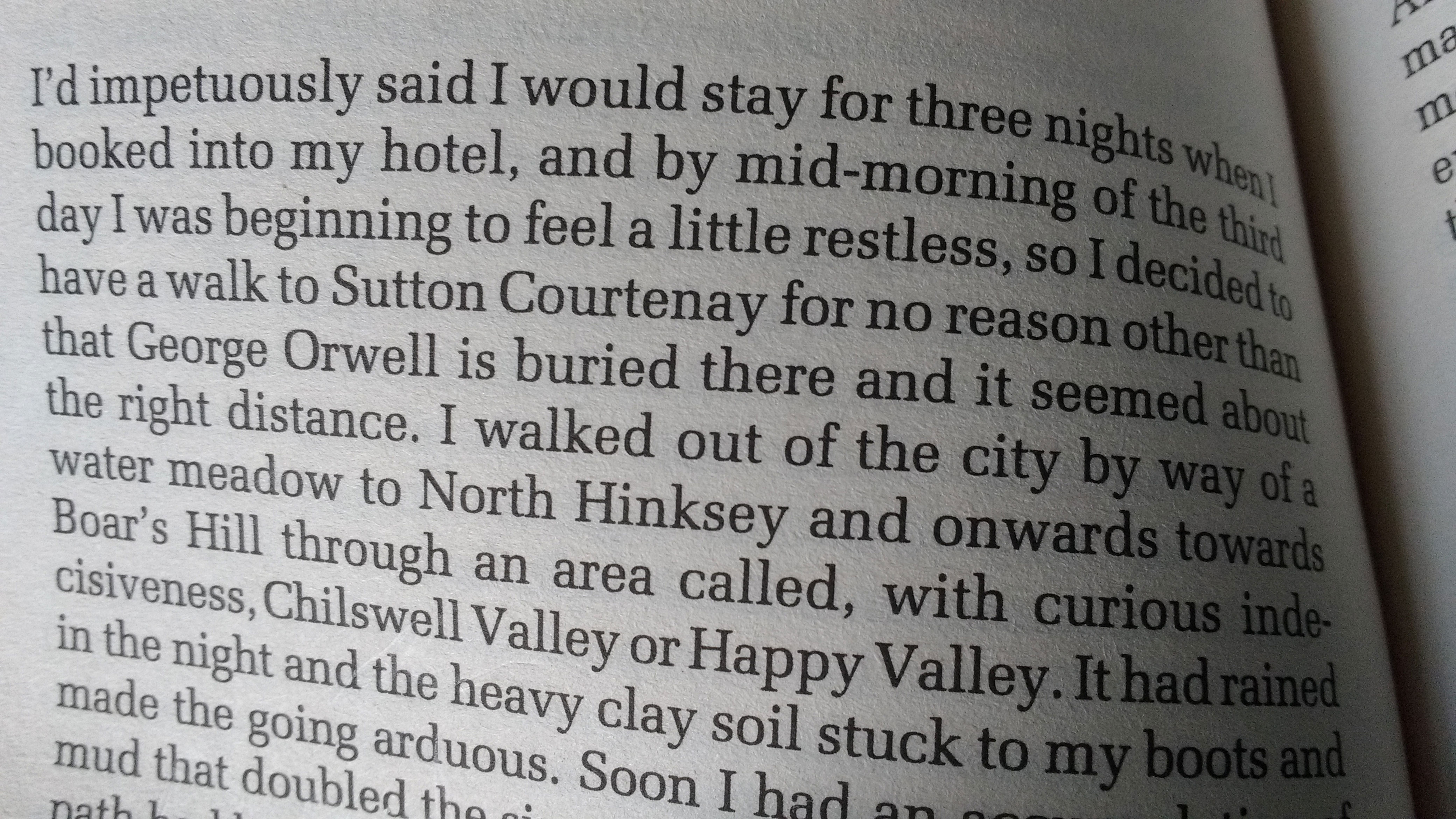
Okay – this is getting a little spooky. Not long ago I admitted to being ashamed at having never read George Orwell’s 1984 until recently, despite loving Animal Farm and The Road to Wigan Pier. In fact, apart from Bill Shakespeare, I’ve read more of Orwell than any other author. Since then, Orwell has been turning up at regular intervals.

Firstly, at my mother in law’s a couple of weeks ago I picked up Bill Bryson’s Notes From A Small Island from the book shelf, flicked it open at a random page and saw this:

orwell-book

A week later, while waiting at a Tube station on the London Underground, my eyes are drawn to a poster advertising a new 1984 play taking place in the city.

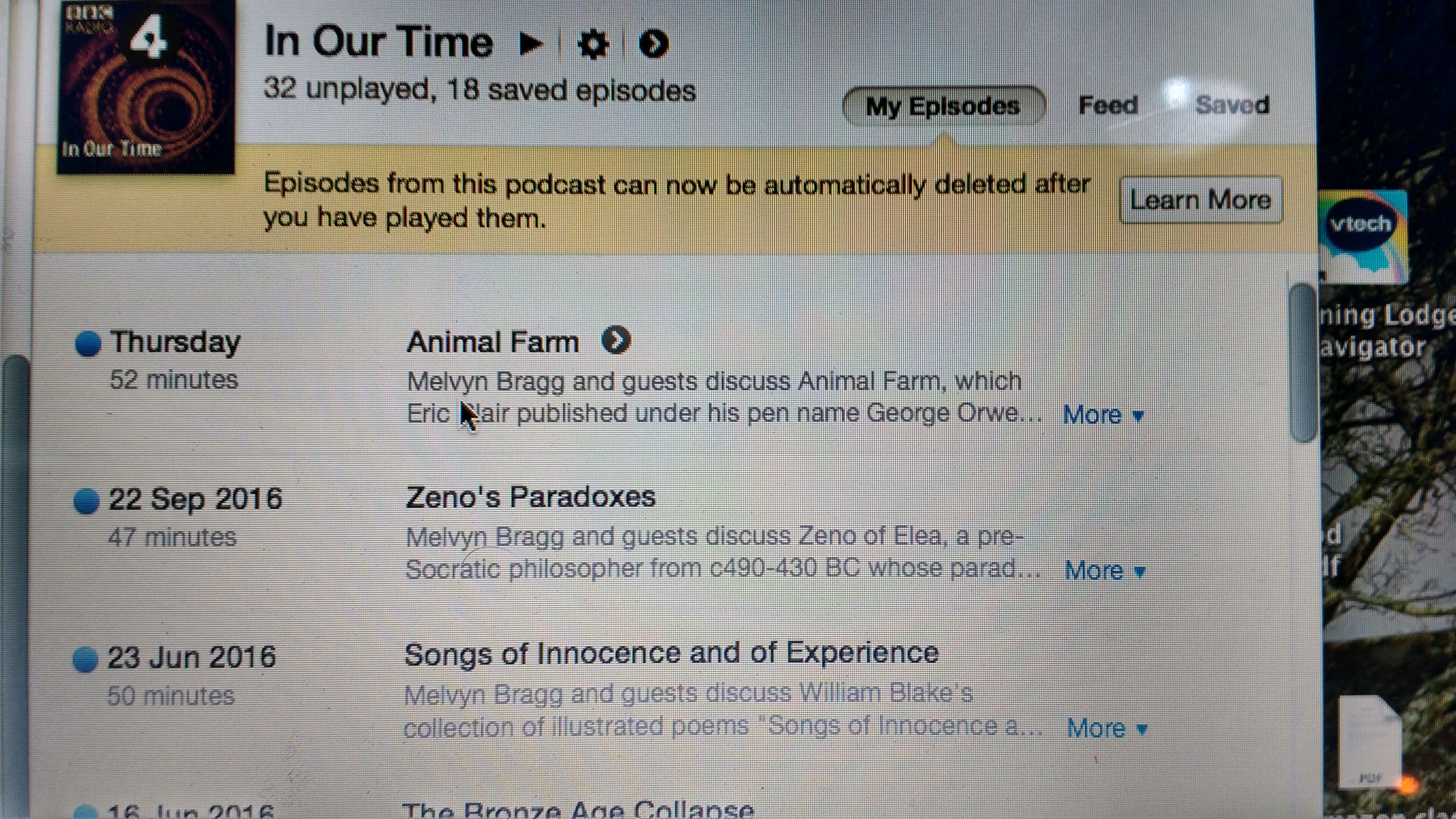
And then tonight, while downloading my podcasts ready for my long M25 motorway drive tomorrow morning, what do I see at the top of a list but this:

orwell-in-our-time

If I didn’t know better, I’d think George was trying to tell me something.