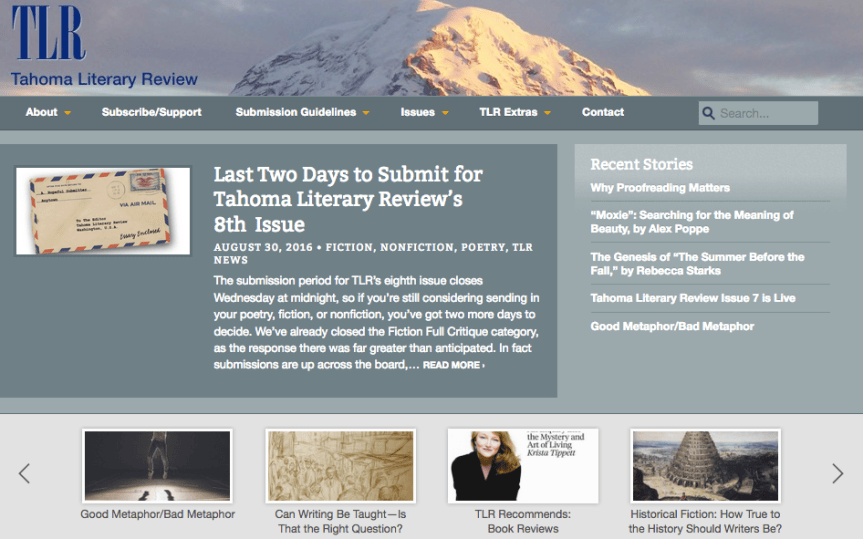
I recently Duotroped the Tahoma Literary Review.
Under the ‘Submission Guidelines’ tab of their website they provide some useful info about what they want to see in a cover letter.
The bit that particularly interested me went as follows:
When writers self-identify in their cover letter or biographical statement, those disclosures help us to do a better job in balancing, for example, the ratio of male and female writers, emerging and established writers, writers from the US and abroad, writers inside and outside academia, younger and older writers, or gay and straight writers in any individual issue.
Laudable, but I couldn’t supply in full what they wanted.
Why? Because I want my work to be judged on its own merits. Now, in the (as my Duotrope experience tells me) highly unlikely event that my work is considered good enough to be exchanged for money rather than another emailed knock-back, I’d hate to think that what got it over the line was the fact that I was an unknown, 15-year old, foreign, lesbian dropout.
Equally, I’d hate to think that my story missed out because I wasn’t.
Of course, any ‘self-identification’ would be forgotten in a moment of mind-shattering ecstasy if I was published by the Tahoma Literary Review, so maybe, in hindsight, I should be less shy about promoting my USPs – it might be the difference between tasting a little success and updating my Duotrope account with one more ‘Submission Response’ rejection.
And that, after all, is the name of this particular game.